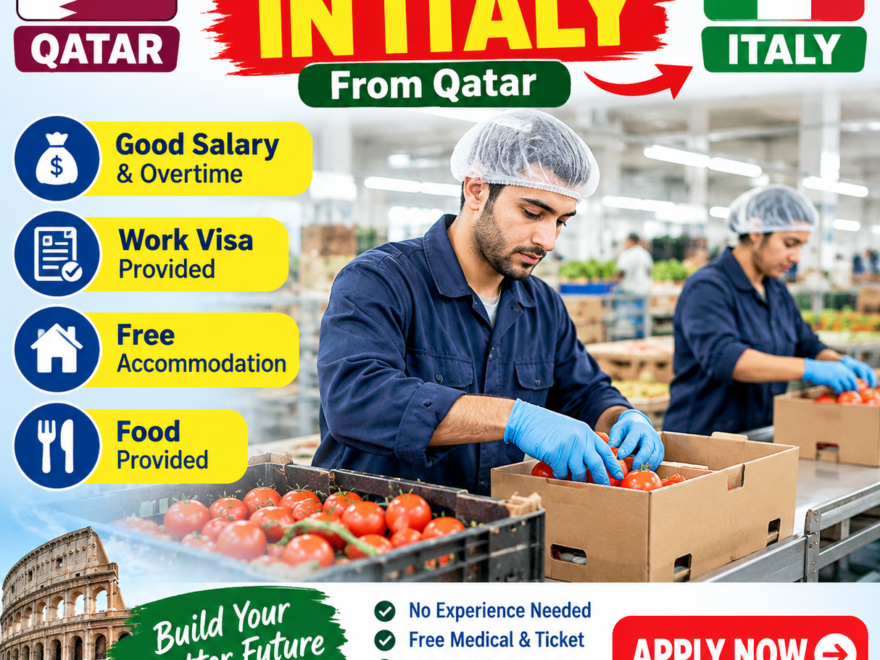
If you work in Qatar and are thinking about a move to Italy, packing and warehouse work can look like an accessible way in. Italy has real demand for packers in food production, fruit and vegetable packhouses, e-commerce logistics, and manufacturing. But the legal route from a non-EU country is more structured than most social media posts suggest, and it is full of scammers.
This guide explains how the process works, what you need, how long it takes, and how to avoid fraud. It is general information, not legal or immigration advice, and rules change, so always confirm details with official Italian sources.
The most important fact: you cannot just “apply and fly”
Most non-EU citizens cannot get an Italian work visa by applying to a job advert. Italy sets a yearly quota of foreign workers who may enter, under a law called the Decreto Flussi. The decree sets how many non-European citizens can enter Italy for seasonal work, non-seasonal employed work, or self-employed work. italiahello
The process starts with the employer, not with you. An Italian employer applies for permission (the nulla osta al lavoro) to hire a specific worker from abroad. Only if that is approved can you apply for the visa. So your real task is to find a genuine Italian employer willing to go through this process for you.
How the current system works
For 2026, the plan allows 164,850 non-EU workers to enter, split into 76,200 non-seasonal, 650 self-employed, and 88,000 seasonal. Employers file through set “click days” after a pre-filling stage on the Ministry of the Interior’s portal. Access requires a digital identity such as SPID or CIE. informazionefiscaleitaliahello
The 2026 click days were:
- 12 January for agricultural seasonal work italiahello
- 9 February for tourism seasonal work italiahello
- 16 February for non-seasonal work italiahello
- 18 February for domestic and family care italiahello
Some further points affect your planning:
- Requests are handled in order of submission, and since 2025 the employer must confirm the application within 7 days of being notified that checks are complete. informazionefiscale
- Private employers can submit a maximum of three applications. informazionefiscale
- Applications can be submitted until 31 December 2026, subject to quota availability. informazionefiscale
Since the 2026 windows have already passed, a realistic plan is to prepare now for the next round. Watch the Ministry of the Interior and Ministry of Labour websites for the 2027 dates and pre-filling window. If you have a real employer contact, they can plan ahead using the same steps.
Does your nationality qualify?
This is the point most articles skip. The quota depends on your nationality, not on the fact that you live in Qatar. Many non-seasonal quotas are reserved for citizens of countries that have cooperation agreements with Italy. One report on the non-seasonal click day named a list of eligible nationalities that included India, Pakistan, Bangladesh, the Philippines, Sri Lanka, Egypt, Morocco and Nigeria, among others. That list changes, and it can differ by category (seasonal or non-seasonal). Check the current circular for the year you are targeting. sky
Living in Qatar can help in other ways: you already have international work experience, and you can more easily get documents such as a police clearance. But it does not give you a special immigration route into Italy.
Step-by-step: from Qatar to your first shift
Step 1: Check eligibility
Confirm that your nationality is covered for the category you want (seasonal packing in agriculture, or non-seasonal packing in manufacturing or logistics). Also confirm that your passport has enough validity (usually at least 3 months beyond your planned stay, though the consulate sets the exact rule).
Step 2: Prepare your profile
Employers value practical, checkable experience. Prepare:
- A one-page CV in English (Italian if you can) listing packing, warehouse, food-handling, or production-line experience
- A reference or experience letter from your Qatar employer
- Any certificates, such as food hygiene training or forklift licences
- A short, polite introduction message you can send to employers
Step 3: Look for genuine employers
Legitimate routes include:
- Direct applications to Italian food producers, logistics firms, and packhouses. Search company websites for the “Lavora con noi” (work with us) page.
- Job boards such as Indeed Italia, InfoJobs, and Subito Lavoro. Many ads are for people already in Italy, so read carefully.
- EURES, the EU job mobility portal, for verified vacancies.
- Recruitment agencies (agenzie per il lavoro), which mostly place candidates already in Italy. Some run overseas programmes for specific sectors.
- Trade and employers’ associations, especially in agriculture, which sometimes coordinate seasonal hiring.
Be honest with yourself: many employers will not sponsor a worker they have never met. Video interviews, a strong CV, and flexibility about location and start date improve your chances.
Step 4: The employer files the nulla osta
If an employer agrees, they handle the online application and must show they can house you and pay legal wages. You cannot file this yourself. Be careful of anyone who claims they can do it for you in exchange for money (see the scam section below).
Step 5: Get your visa
Once the nulla osta is issued, you apply for a national work visa (type D) at the Italian diplomatic mission that serves Qatar. Check the embassy’s website for the current appointment system, fees, and required documents. You will generally need:
- Passport and passport photos
- Nulla osta and the employment contract or offer
- Proof of accommodation in Italy
- Police clearance certificate from Qatar (and possibly your home country), with translation and legalisation if required
- Proof of funds and travel or health insurance, as required
- Completed visa form
Processing times vary widely, so allow for months rather than weeks.
Step 6: Handle your exit from Qatar properly
Before leaving, check the current Qatari rules on notice periods, end-of-service payments, cancelling your residence permit (QID), and any exit procedures. Leaving without settling these can create problems if you ever return to work in the Gulf.
Step 7: Complete formalities after arriving in Italy
- Sign the residence contract (contratto di soggiorno) at the local Sportello Unico per l’Immigrazione, usually soon after arrival.
- Apply for the residence permit (permesso di soggiorno). This is normally due within 8 days of arrival, through the post office kit or as instructed.
- Get your tax code (codice fiscale) from the Agenzia delle Entrate.
- Register with the national health service (SSN) once you hold the permit.
- Open a bank account, which you will need for your wages.
What packing jobs are actually like
Typical tasks include sorting, weighing, boxing, labelling, palletising, and quality checks. Work is often on production lines, in cold rooms, or in warehouses. Shifts can include early mornings, nights, and weekends, and seasonal packhouses get very busy at harvest time.
Pay: Wages are set by national collective agreements (CCNL) for the sector, so they vary by industry, region, and contract level. Entry-level packers typically earn a modest monthly wage that is much lower than many people expect from social media posts. Ask for the CCNL name, the contract level, the gross monthly pay, working hours, and overtime rules in writing before you accept anything.
Where the work is: Northern regions such as Lombardy, Veneto, Emilia-Romagna, and Piedmont have many logistics and food-processing companies. Southern regions such as Campania, Puglia, and Sicily have large agricultural packing seasons.
Language: You can start with basic Italian, but even simple phrases help with safety instructions and daily life. Start learning before you arrive.
Scam warning: how to protect yourself
Because this route is in demand, fraud is common. Treat these as red flags:
- Anyone who asks you to pay a “job guarantee” fee, “quota slot” fee, or “click day fee” before you have a signed offer and an issued nulla osta
- Job offers that arrive unsolicited by WhatsApp or Telegram, especially with unrealistically high pay
- “Agents” who say they can get you a visa without an employer
- Fake embassy or ministry websites, or documents with spelling errors and odd email addresses
- Employers who refuse a video call or will not give a company registration number (partita IVA)
Ways to protect yourself:
- Verify the company on the Italian business register (Registro Imprese) and check that its address and website are real.
- Never send passport copies or money to anyone you have not verified.
- Confirm all steps through official Italian government websites or your embassy.
- Remember that under Italian rules the employer is responsible for the nulla osta application, and a legitimate employer should not ask you to fund it.
If you have already been targeted, report it to the local police in Qatar or to your country’s embassy.
Realistic costs and timeline
Budget for:
- Document costs: police certificate, translations, legalisation, and photos
- Visa fees and any appointment service fee
- Flight to Italy
- Initial living costs before your first payslip, including a deposit if you rent
Timelines depend on when the next click day falls, how quickly the employer files, government processing time, and the embassy’s visa queue. Plan for many months from first employer contact to arrival, and do not resign from your current job in Qatar until you hold the visa.
Frequently asked questions
Can I apply for a packing job in Italy on a tourist visa?
No. A Schengen tourist visa does not permit work, and working illegally risks deportation and future bans.
Do I need to speak Italian?
Not always for entry-level packing, but basic Italian is very useful and can make you a stronger candidate.
Can my family join me?
Family reunification is possible later under specific conditions, including income and housing requirements. It is not automatic.
Is a recruitment agency in Qatar safe to use?
Only if it is licensed and does not charge you illegal fees. Check with the relevant authorities before paying anything.
What if I am not on the eligible nationalities list?
Ask employers about other legal routes (for example, some skilled or student pathways) and check current official quota tables, since categories and lists change every year.
Final thoughts
A packing job in Italy is achievable, but it depends on legal quotas, a genuine employer, and patience. Start by checking your nationality’s eligibility, building a solid CV, contacting verified employers, and following the official steps. Never pay for promises. If you stay careful and informed, you can avoid the biggest risks and give yourself a fair chance.
Disclaimer: This article is for general information only and does not constitute legal or immigration advice. Immigration rules, quotas, and procedures change frequently. Always confirm current requirements with the Italian Ministry of the Interior, the Ministry of Labour, or the Italian Embassy.