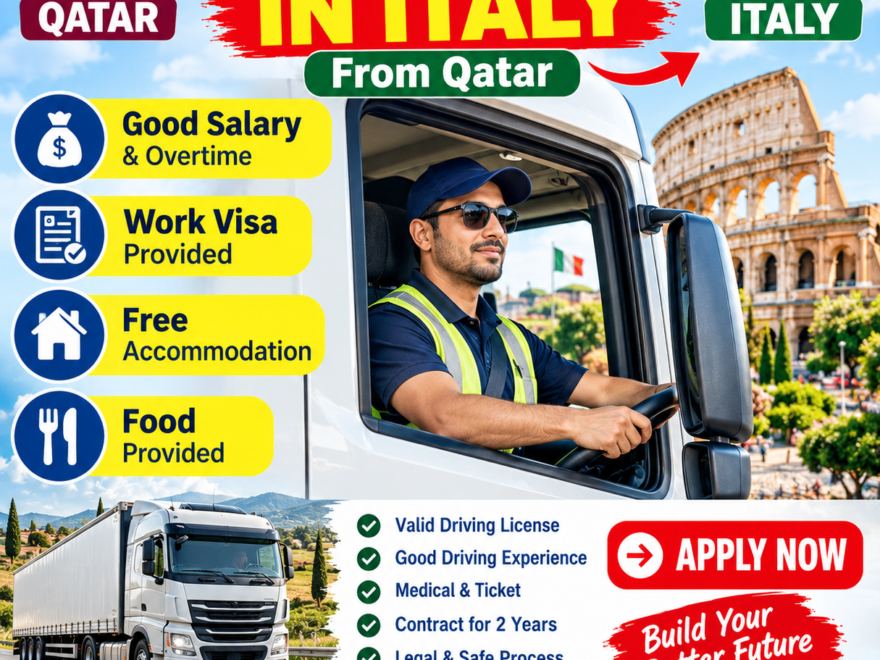
Italy’s transport and logistics sector regularly struggles to find enough professional drivers, and many skilled drivers working in Qatar wonder whether they can move there legally. It is possible, but the process is very different from applying for a job in the Gulf. Italy has no simple “apply and fly” route for non-EU workers, and knowing how the system works will save you time and money and help you avoid scams.
This guide covers the legal route, the documents, the licence rules, the realistic timeline, and the mistakes to avoid. Rules change often, so check the official sources listed at the end before you act.
1. Understand the Basic Rule: The Employer Applies First
In most cases you cannot apply for a work visa on your own. An Italian employer must first obtain work authorisation (the nulla osta) for you. Only after that can you apply for the visa at the Italian consulate.
Italy manages this through the Decreto Flussi, the government’s annual quota system for non-EU workers. The decree covering 2026 to 2028 sets 164,850 places for 2026, within 497,550 across the three years. Only an Italian employer can file the application, on a fixed “click day”, and places are allocated in order of submission until the quota runs out. ApprodoApprodo
The quota system has some important consequences:
- Employers, not workers, submit the application. A recruiter or agency cannot buy you a place.
- Timing matters. Applications are filed on set dates, and popular categories can fill within minutes.
- A quota place is not a visa. It is only the first step.
2. Check Whether Your Nationality Is Eligible
Eligibility depends on your citizenship, not the country where you live. Living and working in Qatar does not by itself qualify you.
For non-seasonal employment, which is where most driving jobs fall, one report on the 2026 click day said eligible workers must be citizens of 34 partner countries, or hold UNHCR refugee status. That list can change and the reporting varies, so confirm it against the official decree or the Italian Ministry of the Interior rather than a third-party site. VisaHQ
Also check whether the job falls within a category that has quota places. Non-seasonal quotas are split by sector, and the decree’s wording matters. Ask any prospective employer to confirm in writing that a driver position qualifies.
3. Know the Timeline and When the Next Window Opens
The 2026 cycle is over, so anyone planning now is looking at the next one. For 2026, the click days were 12 January for seasonal agricultural work, 9 February for seasonal tourism, 16 February for non-seasonal work and 18 February for domestic and care work, with pre-compilation closed on 7 December 2025. The same source says the 2027 cycle follows the same pattern, with pre-compilation expected in late 2026. ApprodoApprodo
In practice this means:
- Late 2026: Employers prepare and pre-fill applications on the government portal.
- Early 2027: Click days open (expect dates similar to this year, but verify).
- After the click day: The local immigration office (Sportello Unico per l’Immigrazione) reviews the application. For non-seasonal work, the officer must issue the nulla osta within 60 days. ImmigraFacile
- Then: You apply for the visa at the Italian consulate covering your area. Since Italy’s diplomatic presence in Qatar is limited, confirm which office handles your case.
Because the process is competitive and employers must be involved months in advance, start your search for a genuine employer now.
4. Find a Legitimate Employer
You need an Italian company that is willing to hire from abroad and understands the quota process. Realistic places to look:
- Italian logistics and haulage companies. Many are family-run firms in northern regions such as Lombardy, Veneto and Emilia-Romagna, where transport activity is heavy.
- Bus and coach operators, including local public transport companies, which occasionally recruit abroad.
- Company websites and Italian job boards. Search in Italian: autista, autista camion, autista patente C/E, autista di autobus.
- Professional networks such as LinkedIn, where you can contact hiring managers directly.
- Trade associations for road haulage and logistics, which can point to member companies.
Be realistic about the odds. Many employers prefer candidates already in Europe, since hiring from abroad means paperwork and waiting. A short, professional application in English, and ideally basic Italian, helps.
5. Understand Licence Requirements
This is often the biggest practical obstacle. It has three parts.
Your existing licence
Italy converts foreign licences without a test only when the issuing country has a bilateral agreement with Italy. One guide notes that conversion without tests is possible only if the issuing country has a bilateral reciprocity agreement with Italy. I could not find Qatar listed among the countries with such an agreement, and Qatari licence conversion pages typically discuss Qatar accepting Italian licences, not the reverse. Do not assume your Qatari licence converts. Check the current list on the Italian Ministry of Infrastructure and Transport website (mit.gov.it) or ask the Italian consulate. Expat Focus
If there is no agreement, expect to take Italian theory and practical exams, usually through a driving school (autoscuola).
Heavy-vehicle categories
Professional driving generally requires the relevant heavy-vehicle categories (C and CE for lorries, D and DE for buses). A Qatari licence for such vehicles does not automatically carry over. Expect to be tested on the Italian categories.
Professional qualification (CQC)
Professional drivers in Italy usually need a Driver Qualification Card (CQC, Carta di Qualificazione del Conducente), which reflects EU-wide professional training and periodic refresher requirements. Ask your prospective employer exactly what they require and who pays for training.
Many people who hold a licence from outside Europe spend several months, and some money, getting properly qualified in Italy. Plan for this rather than assuming you can start driving immediately.
6. Prepare Your Documents
Have these ready early. Consulates and employers often want originals and certified translations.
- Valid passport with plenty of remaining validity
- CV tailored to driving: vehicle types, years of experience, countries driven in, clean record
- Driving licence(s) and, where relevant, any professional certificates
- Employment reference letters, ideally on company letterhead from your Qatar employer
- Police clearance certificate, since some processes require it
- Medical fitness documents, as professional drivers must meet health standards
- Educational certificates, if requested
- Certified translations into Italian, and sometimes legalisation or apostille, depending on the document
Ask the consulate for its checklist. Requirements differ by nationality and consulate.
7. What Happens After You Arrive
Once your employer has a nulla osta and you have your visa, the paperwork continues in Italy. One guide explains that within eight working days of arriving you begin your residence permit application and sign the residence contract at the Sportello Unico, then handle the tax code, bank account, residence registration and health enrolment. Approdo
Typical steps:
- Sign the residence contract (contratto di soggiorno) with your employer
- Apply for the residence permit (permesso di soggiorno) through the post office kit system
- Obtain your tax code (codice fiscale)
- Register your residence at the local municipality
- Enrol in the national health service
- Complete any licence conversion or CQC requirements
8. Pay, Conditions and Cost of Living
Italian drivers are usually employed under national collective agreements (CCNL), which set minimum pay, working hours, rest periods and leave. For road haulage this is typically the logistics, freight transport and shipping agreement. This gives you much stronger legal protections than many Gulf contracts, including regulated driving and rest times enforced through tachograph rules.
Salaries vary by region, employer, experience, and whether the work is domestic or international. Avoid anyone who quotes a high guaranteed figure. Ask for the contract and check the applicable collective agreement. Also budget for rent, which is much higher in the north than in the south, and for the costs of licence conversion and qualification.
9. Avoid Scams: The Most Important Section
Because the system is competitive and confusing, it attracts fraudsters. One immigration guide warns that because the process is employer-led, competitive and time-boxed, it is fertile ground for intermediaries who sell certainty that nobody can sell. The reality behind the hype is also sobering: one analysis reported that only 7.8% of the quotas assigned in 2024 resulted in valid residence and work permits. Many approved places were never completed. ApprodoYourwaytoitaly
Warning signs:
- Anyone who “sells” you a quota place, job offer or visa. Legitimate employers do not charge you to hire you.
- Guaranteed approval. No one can guarantee a nulla osta or visa.
- Large upfront fees by bank transfer or cash to individuals or unregistered agencies.
- Job offers with no contract, no company details and no verifiable address.
- Fake “consulate” or “ministry” emails and websites. Official Italian government sites use domains such as .gov.it and esteri.it.
- Pressure to pay quickly before a “deadline”.
Protect yourself:
- Verify the company through the Italian business register (Registro Imprese).
- Ask for a written job offer and check it against the collective agreement.
- Only pay official fees to official bodies, such as visa fees at the consulate.
- If in doubt, ask the Italian consulate or an accredited immigration lawyer.
10. A Realistic Action Plan
- Confirm your citizenship’s eligibility under the current Decreto Flussi.
- Start now by researching Italian haulage, logistics or bus companies and contacting them directly.
- Clarify your licence position with the Italian consulate or the Ministry of Infrastructure and Transport, since a Qatari licence may not convert without exams.
- Learn basic Italian, which improves both your job chances and your daily life.
- Gather and translate documents ahead of time.
- Watch for the next click-day dates on the Ministry of the Interior’s site (expected pre-compilation in late 2026).
- Verify every offer and never pay for a job or visa.
Frequently Asked Questions
Can I go to Italy on a tourist visa and look for a driving job?
No. A tourist or short-stay visa does not permit work or convert into a work permit in the normal case. Working without authorisation puts you at risk of removal and future visa refusals.
Do I need to speak Italian?
It is not always a legal requirement for the visa, but it matters for safety rules, road signs, dealing with customers and passing licence or CQC tests.
Is driving experience in Qatar recognised?
It counts as work experience on your CV and to employers, but it does not automatically substitute for Italian licence or CQC requirements.
How long does the whole process take?
Plan for many months, and possibly longer than a year once you count finding an employer, waiting for click day, visa processing, and licence and qualification steps.
Can my family come with me?
Family reunification exists under separate rules with income and housing conditions. Check with the consulate or an immigration lawyer.
Official Sources to Check Before You Act
- Italian Ministry of the Interior (immigration and Decreto Flussi)
- Italian Ministry of Foreign Affairs (esteri.it) and the Italian consulate serving Qatar
- Italian Ministry of Infrastructure and Transport (mit.gov.it) for licence conversion
- The national immigration portal for employers’ applications
Disclaimer
This article is for general information only and is not legal or immigration advice. Immigration rules, quotas, eligible countries and licence agreements change frequently. Always confirm current requirements with official Italian authorities or a qualified immigration lawyer before making decisions or payments.